


Which is more appropriate in the construction Industry today? There has been a rapid development in the construction industry. Among the notable changes that we experience today is the increasing need to automate the production of blocks and blocks. Which is more profitable- block machine vs block machine? This is a question many business owners and even contractors usually pose when it comes to the discussion of these machines. Which is more sustainable? And what one guarantees greater growth in the long term?
The Basics: Block machine and Block machine
A block machine has been created to produce concrete blocks, hollow blocks, and pavers utilizing such raw materials as cement, fly ash, sand, gravel, and water. Such machines are based on the technology of vibration and hydraulic compression to achieve homogeneous density and strength.
Conversely, making clay and fly ash blocks is normally done by a block machine. Conventional block machinery is also energy-consuming as it needs to be fired in a kiln. The contemporary block presses, though, are compression molded without firing, but are highly intensive regarding consumption of fuel and labor.
Block machine = high efficiency, modern, and eco-friendly.
Block machine = old-fashioned, labor-intensive, with increased emissions.
Technical Comparison of Block machine versus Block machine
Technical aspects are enormous when comparing a concrete block machine to a block machine.
Block Machine Technology
· Hydraulic pressure + vibration compression.
· Manufactures hollow block, pavers, curbstones, and interlocking blocks.
· Can be run fully automatic or semi-automatic.
· Cement, fly ash, slag, gravel, and sand.
· Attains a high level of dimensional precision and water-insensitivity.
Block Machine Technology
· Clay-based machineries of blocks need kiln firing at 900- 1100 °C.
· Consumption of high fuel (coal, gas, or wood).
· Produces huge carbon emissions.
· Block machines are faster than some of these modern fly ash block machines that are eco-friendly.
Block machines are efficient, versatile, and sustainable.
Block Machine QS2000: Modern Construction Solution with High Efficiency
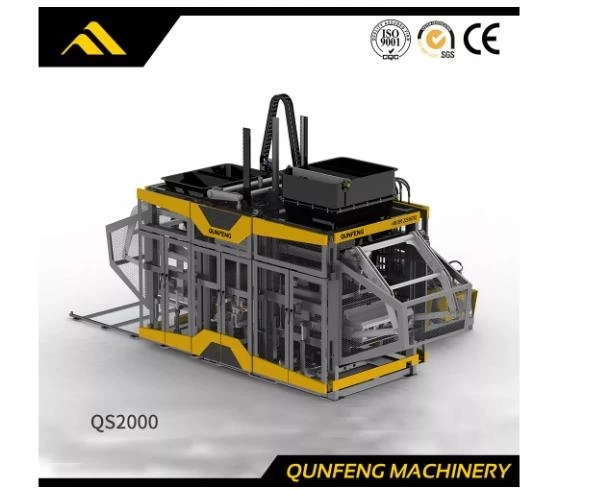
The Qunfeng flagship model is the Block Machine QS2000, designed to provide exceptional performance in the production of concrete blocks on a large scale. This machine, manufactured in state-of-the-art automation and precision technology, is a step in a new direction of productivity, durability, and versatility in the construction materials industry.
High Technology to get optimum productivity
The QS2000 has an effective four-axis serving system that ensures strong, stable, and rapid product forming. This improved system can ensure an improved output with a constant block quality. Its high pallet size allows getting a greater number of blocks per cycle, which can greatly enhance the daily capacity.
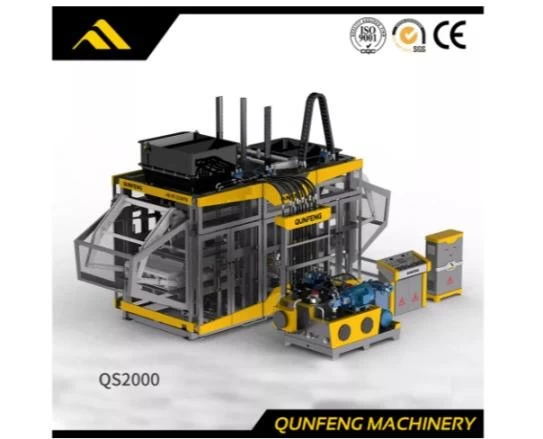
Concrete products that are supported by the machine are solid blocks, hollow blocks, permeable pavers, interlocking blocks, grass-planting blocks, curbstones, load-bearing blocks, and hydraulic concrete blocks. Such flexibility explains why it is a good solution for enterprises that seek to increase the production capacity in various lines of product.
High Quality and stability
QS2000 has an anti-mix color feeding system that improves the surface quality of decorative pavers to have a uniform color distribution. The airbag clamping system is used to extend the life of the mold, decrease mechanical stress, and the imported shock pads offer good shock absorption and noise damping; furthermore, this ensures that the production environment is quiet and smooth.
The machine can be tailored to many different production requirements with a suitable block height of 45-500 mm. Its heavy construction and limited-service options ensure that it is long-lasting, minimizes downtime, and improves the payback.
Industrialization and Easy to use
QS2000 is highly automated and user-friendly, and therefore, it can be used by both seasoned operators and novice production teams. Its smart controls systematize the whole process and thus requires minimal manpower with high-quality standards.
Ideal for Large Enterprises
Specialized to suit large and ultra-large construction material companies, the QS2000 offers unparalleled efficiency to industrial-scale production. Investing in this machine results in increased production, reduced energy use, and high-quality blocks, and at the same time, strength, accuracy, and sustainability requirements in the international standards.
Why Choose QS2000?
· Four-axis servo system to achieve faster, stronger forming.
· Anti-mix color feed system, premium surface finish.
· Airbag clamp to increase the life of the mold.
· Reduced noise, wear, and shock absorption system.
· High-capacity pallet design.
Discover the Block Machine QS2000 in Qunfeng Group to reshape your efficiency and quality of block production.
Comparison of Cost: Investment vs. Long-term Profitability
Cost is one of the largest determinants when it comes to choosing between a making machine and the block making machine.
Block Production Machine:
· Initial Cost: $40,000-80,000 (on the automatic models).
· Minimal operation cost because of less fuel and less labor.
· In 1-2 years, due to the high production and market demand.
Block Machines
Block machines are up to international standards of:
· Compressive strength (more than 15 MPa of load-bearing blocks).
· Water absorption (below 10%).
· Dimensional accuracy (tolerance of +-2 mm).
Block Machines
· Should comply with the kiln emission standards.
· Make the extraction of clay permits.
· The reduction of carbon emissions through the removal of the use of traditional kilns is, in many countries, a gradual process towards carbon neutrality.
· International standards obviously give preference to block machines.
Market Trends: Block machines
· There has been a fast-changing trend in the block and block machinery market.
· There is an increase in demand for environmentally friendly block-producing machines in the Asian regions, Africa, and the Middle East.
· It is owing to sustainability that governments encourage fly ash block plants.
· Construction legislation is encouraging farmers not to use clay in constructing their farms. The future is block-building.
Productivity and Efficiency
Block machines are also more efficient when we compare block machine vs block machine efficiency.
Block machine (automatic): This has a maximum of 8,000-10,000 blocks per shift.
Block machine (clay-based): approximately 3,000 to 5,000 per shift, with greater fuel dependence.
Moreover, block machines are available for 24/7 operation with very little downtime.
Eco-Effectiveness: Block vs Block
Block Production Machines:
· Take cement, fly ash, and waste products.
· Low carbon footprint.
· No firing or fuel based on deforestation.
Clay Block Machines:
· The extraction of heavy soil/clay destroys the farmland.
· Massive CO2 emissions are added with kiln firing.
· The increased fuel dependency leads to more costs in the long run.
· World governments are currently shifting to the support of block-making machines.
Construction Uses
In the construction sector, decision-making on blocks or blocks is heavily based on the magnitude and nature of the construction. Today, large size, strength, and versatility have made blocks the choice for large-scale and modern building. They are extensively used in:
· Wherever load-bearing capacity and uniformity are critical, such as in high-rise buildings.
· Warehouses in industries that require high walls, durability, and quick setup.
· Road pavement is due to special interlocking block designs that can resist heavy traffic.
· Cities' Housing projects, where it is most about speed, economy, and sustainability.
· Small-scale housing, particularly in places where manual labor is available.
· Construction in the rural areas where the clay block machine is still prevalent.
· The partitions and boundary walls, where both customization and aesthetics have precedence.
Nevertheless, block machines are the best for large-scale infrastructure and projects that are future-proof. They are more efficient, environmentally friendly, and reliable in quality and are the mainstays of the contemporary way of construction.
Prospect of Block Making
As the world grows at a fast rate in construction, there will be more demand for homogeneous, sturdy, and sustainable blocks. Eco-friendliness and automation are the future.
· In the coming ten years, the world block and block industry will become dominated by block production machines.
· Conventional clay block machines will fall out of favour because of environmental constraints.
· New standards will also be established in the industry, with smart factories having fully automated block machines.
· Establishing a business investing in block machines is future-proofing a business.
Which is Better?
In the contest of block machine vs block machine, therefore:
· Block Machine Wins
· Higher efficiency
· Sustainable production
· Better ROI
· Meets global standards
· Block Machine Loses
· High fuel costs
· Environmental restrictions
· Limited scalability
And in case you are intending to invest in construction machinery, then it is obvious that block machines are the future of modern construction. To get some sophisticated solutions, consider Qunfeng block and block production equipment- globally reputed as being innovative, efficient, and sustainable.
Conclusion
When it comes to block machine vs block machine, it will be a matter of efficiency, cost, sustainability, and future growth. Although they may seem cheap initially, compared to the other machines, which are more cost-effective to use in the long run, block machines have high operating costs, are reliant on fuel, and are subject to regulations. Block machines, on the other hand, are more automated, greener, and quicker to ROI. They are in line with the current construction requirements, global quality benchmarks, and global sustainability aspirations. In case of your interest in more sophisticated solutions, visit the block and block machines of Qunfeng that guarantee high quality, stability, and future-oriented equipment.