


A high-rated capacity does not always produce a high number of sellable blocks. Some factories select an Interlocking Block Making Machine mainly by cycle time but later encounter incomplete mould filling, variable block weight, chipped corners, dimensional deviation or insufficient curing capacity.
A reliable selection process should evaluate three connected factors:
• Qualified output: Calculate accepted blocks per shift, not only theoretical press cycles.
• Raw-material compatibility: Confirm that local aggregates, cement and additives can form consistently.
• Forming technology: Match vibration-hydraulic or static pressing technology to the target product.
Start with the Finished Block
The "Interlocking block" refers to paving blocks, solid blocks, slope-protection units, masonry blocks or compressed-soil blocks. Each product requires a different material recipe, mould structure and forming method.
Selection Factor | Concrete Pavers and Solid Blocks | Interlocking Masonry or Soil Blocks |
Typical use | Roads, plazas, parking areas and landscaping | Walls, retaining structures and low-rise buildings |
Main materials | Cement, sand, graded aggregate and pigment | Soil, sand, cement or lime stabilizer |
Forming method | Static pressing or vibration-pressure forming | Hydraulic or mechanical pressing |
Key controls | Density, strength, abrasion and finish | Strength, interlock geometry and dimensions |
Prior to Interlocking Block Making Machine analysis, stipulate the following:
• Block dimensions: Common examples are pavers sized at 200 × 100 × 60 mm and square units at 250 × 250 × 60 mm.
• Product height: Specialized static press systems may be in the range of 45 mm to 120 mm.
• Surface finish: More uniform feeding is required for terrazzo and imitation stone products as compared to basic solid blocks.
• Loading conditions: Pavers designed to bear vehicles usually require a higher density and greater resistance to abrasion than those designed for pedestrian use.
• Dimensional tolerance: Variation in height can lead to paving not being flat and misalignment of joints.
Calculate Sellable Output
Theoretical capacity should be converted into qualified output using:
Sellable output = pieces per cycle × cycles per hour × operating hours × utilisation × pass rate
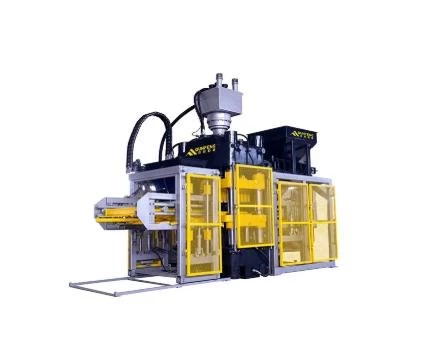
Consider an Interlocking Block Making Machine with an approximately 1100 × 950 mm forming area and a 20–25-second cycle.
Product Size | Pieces per Cycle | Theoretical Hourly Output |
240 × 115 × 53 mm | 39 | 5,616–7,020 |
200 × 100 × 60 mm | 28 | 4,032–5,040 |
250 × 250 × 60 mm | 9 | 1,296–1,620 |
For a 200 × 100 × 60 mm paver at a 22.5-second cycle:
• Cycles per hour: Approximately 160
• Output per cycle: 28 pavers
• Theoretical hourly output: 4,480 pavers
• Eight-hour rated output: 35,840 pavers
• Estimated sellable output: Approximately 28,941 pavers at 85% utilisation and a 95% pass rate
The difference may result from:
• Mould cleaning and product changes
• Moisture and feeding adjustments
• In-process quality inspections
• Hydraulic and mould maintenance
• Cracks, incomplete corners or surface defects
• Downstream handling and curing interruptions
Buyers should request rated output, stable operating output and qualified output as separate figures.
Match the Interlocking Block Making Machine to Local Materials
Even an Interlocking Block Making Machine with 8000 kN, or 800 tons, of pressing force cannot correct unstable moisture or unsuitable aggregate grading.
Raw Material Specifications
• Maximum size of aggregate: Should be appropriate for the required block thickness, and details of the block mould.
• Aggregate grading: A good balance of coarse and fine grading reduces voids and lowers cement demand.
• Moisture consistency: Dry consistency is required for the concrete to flow to the mould, but its green strength is retained.
• Fine-particle content: An excess of fine particles (dust) increases the sensitivity to moisture and may restrict the flow of the material.
• Cement dosage: Affects the strength of the concrete after demoulding, the rate of curing, and the final compressive strength.
• Recycled aggregate: Absorption, density and contamination should be controlled by batch.
• Face-mix material: Decorative pavers may require a separate fine-material feeding system.
Production Trial Records
For each recipe, document:
• Batch moisture variation
• Mould-filling time
• Block weight by mould position
• Product-height consistency
• Edge and corner integrity
• Surface pores and colour variation
• Strength after curing
• Final rejection rate
The material should fill the complete mould within the planned 20–25-second cycle without creating large weight differences between cavities.
Compare Forming Technologies
Forming Technology | Main Advantage | Main Limitation | Suitable Products |
Basic hydraulic pressing | Lower initial investment | Greater operator dependence | Small-volume solid blocks |
Vibration-hydraulic forming | Flexible product range | Requires pallets and vibration control | Hollow blocks, pavers and curbstones |
High-force static pressing | High density and refined finish | Requires accurate feeding | Pavers, solid blocks and terrazzo |
Fully automatic line | Stable continuous production | Higher infrastructure demand | Industrial and municipal projects |
High-Force Static Pressing
An industrial static-press Interlocking Block Making Machine may provide:
• Main forming force: Up to 8000 kN
• Maximum cylinder pressure: Approximately 30.5 MPa
• Product-height range: Approximately 45–120 mm
• Moulding cycle: Approximately 20–25 seconds
• Forming area: Approximately 1100 × 950 mm
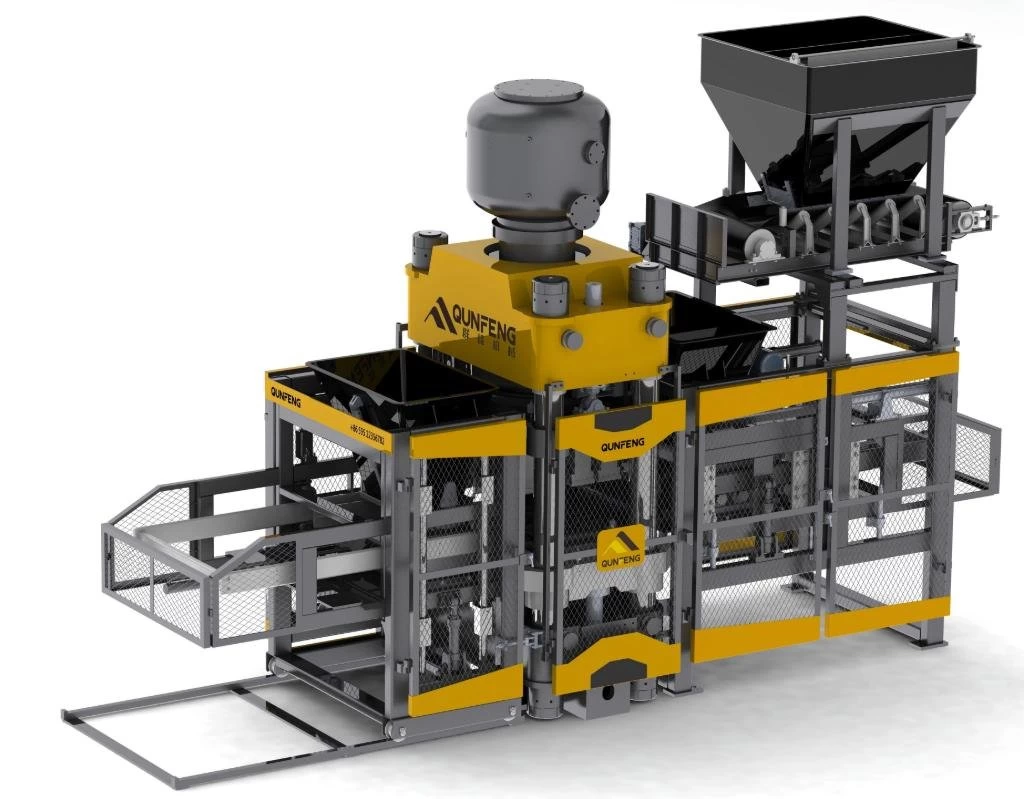
These parameters support high density, stable block height, defined edges and premium surfaces. However, buyers should assess pressure distribution across the entire mould—not total tonnage alone.
Assessment of Materials Distribution
Feeding unevenly causes variation in weights, densities, and strengths in the same mould. Some advanced feeding technologies are:
• Dual-motor control: Allows for independent control of the timing of front and rear feeding.
• Rotating blades: Allows for distribution of material in the complete area of the mould.
• Micro-vibration: Aids the dry mix to enter corners and detailed cavities.
• High-frequency feeding: Increases the efficiency of filling and reduces excessive feeding cycle noise.
• Multi-cavity consistency: Allows for an equal distribution of material mass, in as many as 39 units, per cycle.
Consider Pallet-Free Production
A pallet-free Interlocking Block Making Machine removes conventional production boards from the forming cycle.
Potential advantages include:
• Reduced pallet purchasing and replacement
• Less storage and circulation space
• Fewer cleaning and return-conveyor requirements
• Lower risk of stoppages caused by damaged pallets
• Simplified internal production logistics
Buyers must still verify how fresh products are discharged, transferred and arranged for curing.
Compare Energy per Qualified Block
Installed power does not equal actual consumption. A large automatic system may have approximately 138.6 kW installed power, while operating demand changes with pressure, cycle load and idle time.
Hydraulic-electric servo control can:
• Adjust motor output according to load
• Reduce idle-state electricity consumption
• Improve hydraulic pressure response
• Potentially reduce energy use by approximately 30% compared with conventional motor configurations
The most useful comparison is kWh per 1,000 qualified blocks, not installed power alone.
How Qunfeng Supports Technology Matching
Qunfeng integrates technologies for advanced Interlocking Block Making Machine projects(QP800), including:
• Pallet-free static forming
• Up to 8000 kN high-force pressing
• Servo hydraulic energy control
• Approximately 1100 × 950 mm large-area forming
• Dual-motor and micro-vibration feeding
• Multi-product mould configuration
• Batching, mixing, conveying, curing and handling integration
Final cycle time, mould layout, output and energy use should be verified using the buyer's actual materials and approved block specifications.
Match the Complete Production System
Selecting an Interlocking Block Making Machine requires more than comparing pressure, motor power or hourly capacity. Block dimensions, aggregate grading, moisture, mould design, feeding accuracy, curing and logistics must operate as one system.
Share the target products, raw-material data, required qualified output, factory layout and electrical conditions with Qunfeng to develop a production configuration based on measurable project requirements.
FAQs
Q1. How does Qunfeng's Interlocking Block Making Machine enhance material feeding consistency?
Qunfeng uses dual-motor feeding along with independently controlled timing, distributing blades, and micro-vibration to help achieve a more uniform distribution of dry concrete to the mould.
Q2. Can we use raw materials sourced locally?
Yes. However, we recommend some testing of the aggregates for gradation, moisture, cement content, particle size, and flowability. We suggest production-equivalent trials after deciding the machine and mould configuration, to verify the setup.
Q3. What is pallet-free block forming?
Pallet-free forming presses and discharges products without the need for traditional production boards. This helps to eliminate the expenses associated with the purchase, storage, circulation, cleaning, and replacement of pallets.
Q4. What is the maximum forming force provided for high-density pavers?
Using Qunfeng's leading edge static-press technology, the maximum main forming force for high-density pavers and solid concrete products is 8000 kN (800 tons).
Q5. How does the use of servo hydraulic control help to lower energy consumption?
The main advantage of the servo hydraulic system is that the output of the motor is regulated based on the pressure load, which, under optimal working conditions, may result in a 30% decrease in energy consumption relative to traditional motor systems.