


Hydraulic Block Making Machine selection becomes much easier when you focus on one question: can the machine fill the mold quickly, evenly, and quietly—cycle after cycle? From QUNFENG’s manufacturing perspective, “Quiet Micro-Vibration, Faster Uniform Fill” is not a marketing phrase. It is a practical method to stabilize quality, reduce rework, and keep output predictable even when raw materials or operator habits change
Quiet Micro-Vibration: The Most Overlooked Quality Driver
Many buyers judge a Hydraulic Block Making Machine by press tonnage first. Tonnage is important, but it does not fix a poor fill pattern. If the mold fills unevenly, the press will simply compact an uneven distribution into a “finished” defect. You may see it as edge chipping, color shading, density differences, or inconsistent block weight.
Quiet micro-vibration is designed to solve this upstream problem. Instead of relying on loud, heavy vibration that can become unstable, the system uses controlled micro-vibration during feeding. The goal is to help the mix “settle” naturally into corners and cavities before pressing. When vibration is controlled and targeted, you get smoother flow behavior and less random bridging in the hopper.
From a factory perspective, quieter operation is not only about comfort. It often indicates the vibration energy is being used more efficiently—less chaotic movement, more useful compaction preparation, and fewer surprises during shift changes.
Faster Uniform Fill: Where Output and Profit Meet
Uniform fill is the bridge between “fast cycle time” and “stable quality.” A Hydraulic Block Making Machine can have a good cycle time on paper, but if operators must slow down to correct feeding issues, real production will not match the specification.
When the mold fills faster and more evenly, operational stability rises immediately:
✓ Stable cycle performance: fewer distribution-related slowdowns keep the line running to plan.
✓ Consistent block mass: reduced weight spread lowers the chance of rejection or end-user complaints.
✓ Cleaner surface finish: uniform fill supports smoother faces, sharper edges, and higher visual consistency—important for premium pavers and terrazzo-style products.
In other words, faster uniform fill is not only an efficiency feature. It directly affects the sellable grade of your output. That is why QUNFENG places “fill stability” at the center of QP800’s design logic.
How Micro-Vibration Works With Feeding to Keep Distribution Even
In real production, the mix is not always “perfect.” Aggregate size, moisture, and additive ratios can vary slightly across batches. These small changes can cause bridging, clumping, or uneven flow, especially when the mold area is large.
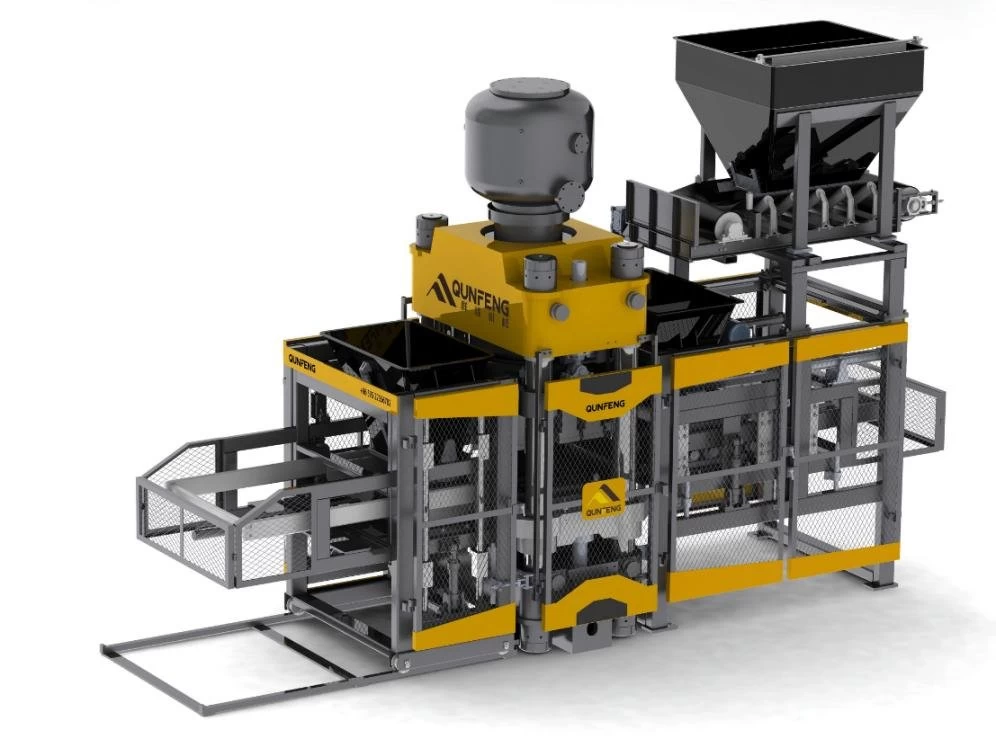
A practical Hydraulic Block Making Machine should help the plant tolerate these variations. The QP800 approach combines micro-vibration with a rotating blade feeding mechanism, allowing material to move and settle more evenly across the mold. Instead of dumping material and hoping it spreads, the system supports a controlled, repeatable feeding routine.
This is where the benefit becomes very concrete: when material distribution is stable, you spend less time adjusting settings, reducing the need for manual intervention. The machine feels “easier to run,” and quality depends less on a single experienced operator.
Why Uniform Fill Supports High-Density Products
Once fill is even, high-pressure static pressing can do its job properly. With 8000 KN (800 tons) main pressure, QP800 is built for high-density compaction. But the pressing force is most valuable when the mold cavities are already filled evenly.
For buyers producing high-strength pavement blocks or dry PC terrazzo tiles, this combination is critical:
• Uniform fill supports consistent structure across the product.
• Static high pressure builds density and strength without aggressive vibration damage.
• Repeatability improves batch-to-batch consistency, which is essential for project deliveries and long-term customer trust.
This is also why many premium product lines prefer “controlled feeding + strong static pressing” rather than relying on heavy vibration alone.
Quiet Operation Is Also a Maintenance and Management Advantage
Noise and vibration behavior often reflect mechanical stress. When a Hydraulic Block Making Machine uses uncontrolled high vibration, it may increase wear on fasteners, frames, and moving parts over long-term operation. By focusing on micro-vibration and controlled feeding, the machine can support a more stable working state.
That stability helps management in practical ways:
✓ Less unplanned downtime caused by loose components or repeated alignment corrections
✓ Simpler training because the feeding behavior is predictable and easier to standardize
✓ More consistent production reporting because output is less affected by operator “style”
In short, quiet micro-vibration is not only about sound. It is part of building a calmer, more measurable production routine.
CTA: How to Evaluate the Right Hydraulic Block Making Machine for Your Line
If your current pain points include uneven fill, noisy feeding, weight deviation, or “good days and bad days” in quality, it is time to evaluate the filling system—not only the pressing force.
Call-to-Action
If you are sourcing a Hydraulic Block Making Machine focused on Quiet Micro-Vibration and Faster Uniform Fill, contact QUNFENG with your target product type (pavers, solid blocks, terrazzo tiles), block height range, and your current feeding issues. We will recommend a practical QP800 configuration, explain how micro-vibration + controlled feeding improves fill uniformity, and provide a manufacturing-ready quotation path for stable, repeatable output.